|
Step1
|
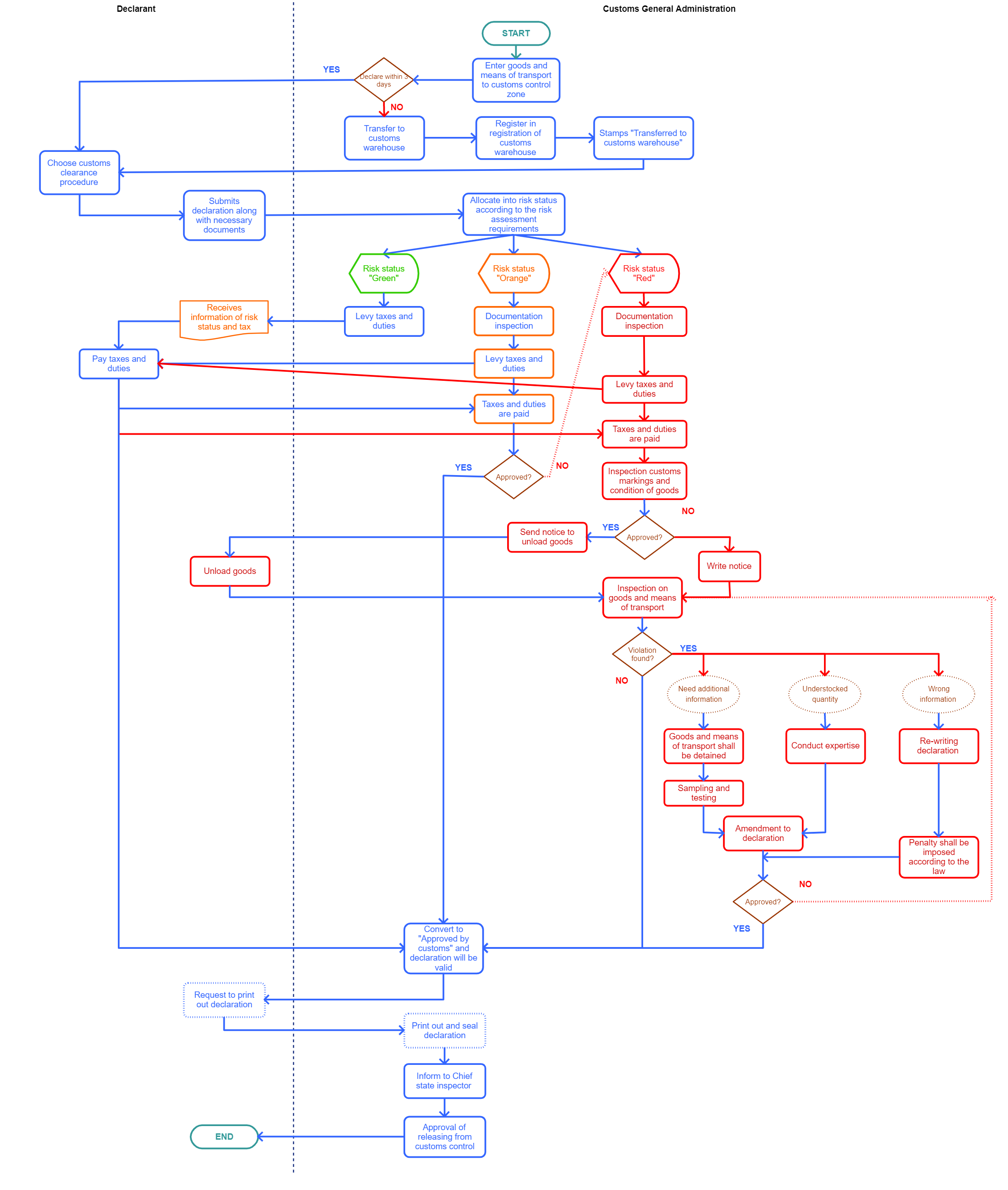
Goods and means of transport enters to the customs control zone. The manifesto shall be used for taking goods and means of transport under customs control before declaring them at the Customs
|
|
|
Step2
|
Declarant chooses customs clearance regime
|
|
|
Step3
|
Declarant submits declaration and other necessary documents of chosen regime
|
|
|
Step4
|
The State Customs Inspector in charge of customs documentation shall examine the Customs declaration and accompanying documents
|
|
|
Step5
|
Levy customs and other taxes
|
|
|
Step6
|
Declarant pays customs and other taxes and fees
|
|
|
Step7
|
Based on the criteria previously included in the risk management program, the control status of goods and means of transport crossing the Customs border shall be expressed in red, orange and green
|
|
|
Step8
|
The declarant shall be informed about the customs control status specified above step
|
|
|
Step9
|
For payment of Customs and other taxes on goods with a Customs declaration selected in the green state, the Customs shall agree and the declaration shall enter into force
|
|
|
Step10
|
For payment of Customs and other taxes on the goods with the declared customs declaration in Orange state, the Customs shall agree and the declaration shall enter into force after completion of customs control on documents submitted
|
|
|
Step11
|
The official in charge of violation shall submit the information on the Customs violation related to the selected goods and means of transport under Customs control to the senior state customs inspector
|
|
|
Step12
|
Before the commencement of the inspection on goods and means of transport, the state customs inspector conducts inspection on customs markings placed on the goods and means of transport, and general condition of the warehouse in the presence of the representative of the transport organization
|
|
|
Step13
|
Before inspecting the goods, the declarant shall be notified to create conditions for customs inspection and unload the cargo
|
|
|
Step14
|
The goods imported across the Customs border shall be checked in detail for compliance with the Customs declaration, including the type, brand, classification, purpose, weight and quantity, standard and level of processing of the goods
|
|
|
Step15
|
Goods and means of transport shall be detained if it is necessary for the Customs laboratory and professional organization to issue an opinion, analyze, obtain information and inquiries from professional organizations
|
|
|
Step16
|
In case the goods are found to be understaffed, underweight, cracked or damaged by the Customs inspection, the MNCCI shall obtain a certificate on the quantity and quality of exported and imported goods and enter the specified quantity in Table F of the declaration
|
|
|
Step17
|
In case the actual quantity exceeds/insufficient the declared quantity during the inspection, the Chief State Customs Inspector shall be notified and the quantity to be specified in Table F of the declaration shall be entered as follows
|
|
|
Step18
|
In case of no violation was found during inspection, the chief state customs inspector in charge of customs control clicks “Approved” button and it validates the customs declaration
|
|
|
Step19
|
If the declarant requests to print out customs declaration, the state customs inspector in charge of documentation shall print it and affix the control mark to the customs declaration specified in the Customs clearance procedure code specified in Table 1 of the Customs declaration
|
|
|
Step20
|
Customs Control Zone Holder shall send a request to remove the goods from the Customs Control Zone to the Chief State Customs Inspector in charge of Customs Control and Inspection working in the Customs Control Zone and Chief inspector allow the goods and means of transport to leave the customs control zone
|
|